
An Open Letter To Aryna Sabalenka
Aryna Sabalenka,
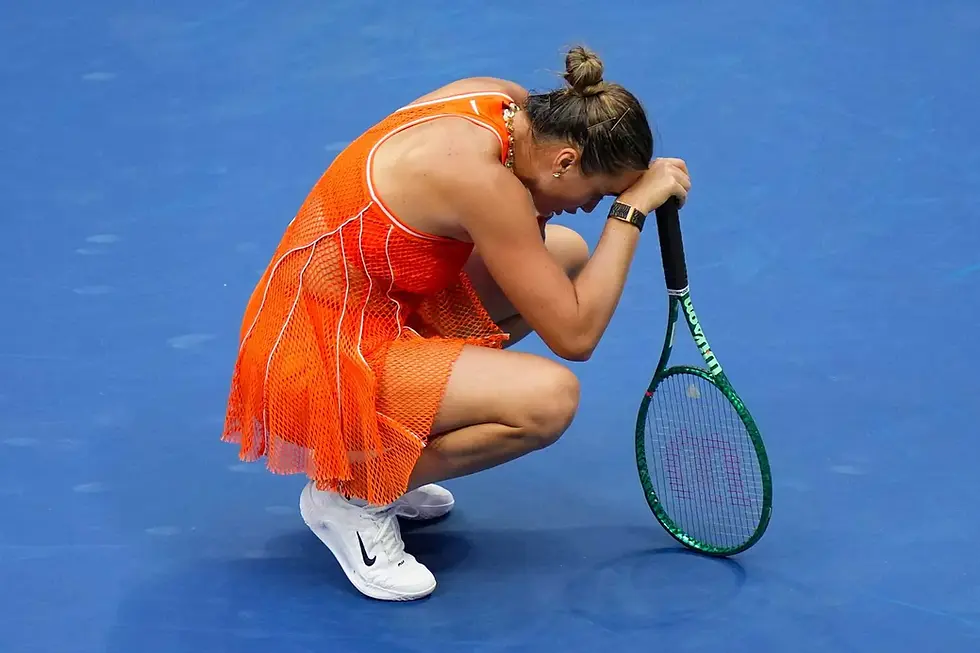
Everyone seems to think your emotions got in the way at the US Open Final. I don’t. I’ve seen the headlines of people saying you lost your cool and recommending you get a sport psychologist. Some say you lost control of your emotions and some are even calling you a bad sport for smashing your racket. I disagree. Your emotions, your passion, and your competitive fire are what drew me to you—not only as a fan, but also as someone who made a career of studying great athletes and coaches.
I don’t think emotions are what got in your way; I think it was how much you were thinking about the results. Your drive to win has led you to the top of the sport. You spent 99 weeks as the No. 1 player in the world. But I wonder if that same drive to win started working against you in this match.
There was a moment in the 3rd set where this became evident to me. It was the 2nd game. You were down 30-0. You hit a return into the net, shook your head, and said something to yourself or your box. You walked into position to return the next serve. Elena Rybakina served it down the middle and you didn’t go for it. You weren’t late. You didn’t reach for it and miss. You just didn’t go.
By then, you would’ve had to win 3 points in a row to get you back in the game. Unlikely? Sure. Impossible? Definitely not.
I can’t know what you were thinking in that moment. But to me it looked like you weren’t playing the point because you were consumed by the outcome. You weren’t thinking about what you could do with the ball in front of you. You were thinking about what that game meant for your chances of winning.
When you’re in the present moment, you move, you compete, you play the point happening now, and you go for it. When you’re caught up in the results, you’re focused on something you can’t control. Winning takes you out of the moment. When you’re no longer present, it becomes much harder to play.
I think that’s what happened to you. It wasn’t because you were too emotional. It was because winning had become more important than competing. That shift in attention is what took you out of the match.
I spent most of my career in basketball, so tennis is newer to me. But from what I’ve observed, emotional expression is part of the sport. Rackets get smashed. Players yell, cry, and get angry. And honestly, I don’t understand why tennis expects you to endure an entire championship ceremony and happily hold your 2nd place trophy on stage immediately after losing.
You smashed a racket. You wanted the camera out of your face. You were disappointed and angry. That does not mean you lost your cool.
Expressing an emotion does not mean you are out of control. And hiding your emotions does not mean you are in control of them. Expressing what you feel is how you process the emotion. That’s exactly what you did. You got angry, expressed the anger, and you moved through it. You still congratulated your opponent. You still addressed the media after.
I don’t think your emotions were the enemy. I hope you never dial back that part of yourself. Your passion is an integral part of your game. Your fire is what makes you such a beast.
I think you were trying so hard to win the US Open that it prevented you from winning the point in front of you. You can’t control whether or not you win the US Open. You can only control whether you go for the next ball. Arthur Ashe has this great quote, “You’ve got to get to the stage in life where going for it is more important than winning or losing.” It’s one of the hardest lessons to learn in sports. Because of course winning is important. But the second it becomes the most important thing, you stop going for it. And going for it is what gives you the best shot at winning.
I was thinking about all this while watching the men’s final on Sunday. When Zverev won the championship point, he had no idea. He walked back into position to return the next serve. The crowd stood and cheered. He adjusted the strings on his racket, then looked up at them confused. Then he realized it. Later he explained, “I forgot about the score.” He was so absorbed in the moment and playing tennis that he did not know he had won the US Open.
I’ve never been a pro athlete. I’m only a year older than you, so it feels ridiculous to give you advice. But I’ve spent years studying championship coaches and athletes and noticed a common thread. So don’t take it from me. Take it from them. From John Wooden, Nick Saban, Michael Phelps, Pat Summitt, Geno Auriemma, Dawn Staley, Michael Jordan, Kobe Bryant, Steph Curry, Bill Russell, Tom Brady, and many more.
The answer is not to become less emotional. It’s not to stop wanting to win.
It’s to stop thinking about winning so you can focus on what you need to do in the moment.
It’s to ignore the results and play the ball in front of you.
Go for it, and let winning take care of itself.


